How to Choose the Right V Groove Bearing?
Choosing the right V Groove Bearing is not simply a matter of matching dimensions. The bearing must suit the rail profile, load direction, travel speed, and working environment. A wheel that fits perfectly on paper may still produce noise, vibration, or premature wear in service. That is why careful selection starts with the application, not the catalogue.
In practical installations, I examine the guide rail surface, mounting space, expected load, and movement pattern. A hardened steel track may support demanding industrial movement, while stainless steel can be more suitable near moisture or frequent cleaning. Sealed bearings help resist dust and debris, but seals can also increase friction. Small details matter. Even the wrong spacer width can create uneven contact and shorten service life.
This guide explains how to compare V Groove Bearing options with greater confidence. It covers groove geometry, bearing materials, load ratings, lubrication, sealing, precision, and supplier documentation. Reliable manufacturers should provide clear specifications, test information, and traceable quality controls. Still, no selection method is perfect. Real conditions often differ from design assumptions, especially when shock loads or poor alignment appear later. A sensible choice leaves room for inspection and adjustment. Measure carefully. Check the rail. Question optimistic claims. With field experience and verified technical data, engineers can select a bearing that performs consistently rather than merely looking suitable in a product list.
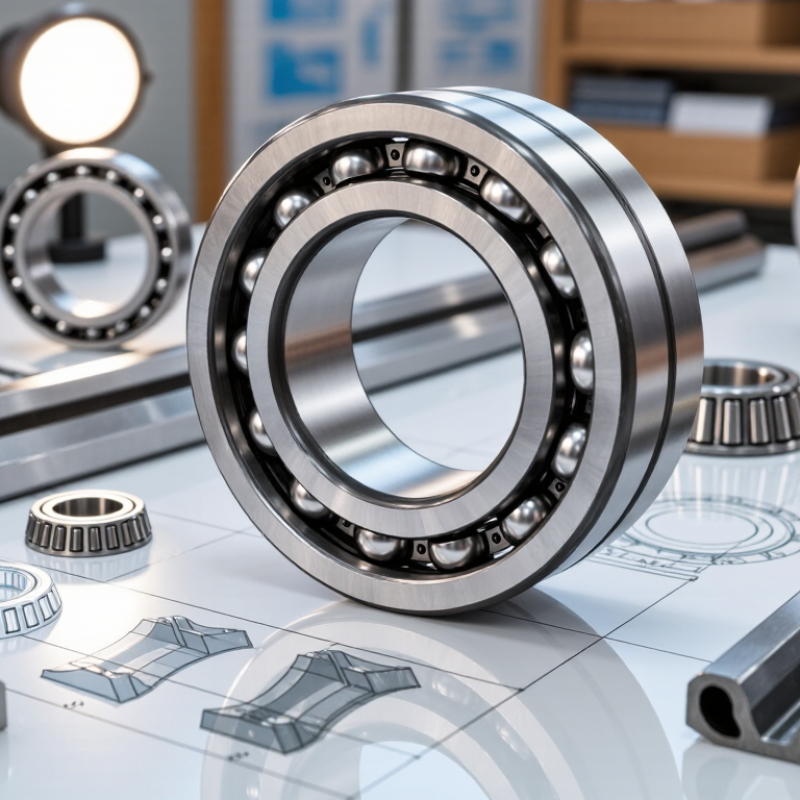
Define V-Groove Bearing Types, 90° Track Angles, and Load Configurations
How to Choose the Right V Groove Bearing?
Choosing a V groove bearing starts with identifying the bearing type and track geometry. Common options include single-row, double-row, shielded, sealed, concentric-stud, and eccentric-stud designs. Each type suits different space, adjustment, and contamination conditions. A sealed bearing may resist dust better, while an eccentric stud helps control preload. Size alone is not enough.
The 90° track angle needs careful attention. Many V groove systems use a 90° included angle, with two matching faces supporting the bearing. The rail and bearing must share compatible angles and contact dimensions. A small mismatch can create edge contact, noise, and uneven wear. Measure the track before ordering. Do not trust appearance alone. In practice, painted rails and worn corners can hide poor geometry.
Load configuration also determines the correct choice. Radial loads press the bearing toward the track, while axial loads act along its direction. Moment loads become important when the carriage is wide, offset, or frequently accelerated. Combined loads may require two or more bearings, spaced apart to improve stability. Check static and dynamic load ratings, then consider shock, speed, travel cycles, and preload. I often allow a safety margin, but excessive preload can increase friction and heat. Real installations are rarely perfect. Alignment, lubrication, and mounting stiffness can change performance more than expected. A careful trial fit may reveal problems that calculations miss.
Match Bearing Load Ratings with ISO 281 L10 Life Calculations
How to Choose the Right V Groove Bearing?
Match Bearing Load Ratings with ISO 281 L10 Life Calculations
A V groove bearing must handle more than its catalog load rating. Wheel alignment, track hardness, speed, and contamination can change the real load. ISO 281:2007 defines L10 life as the point when 10% of identical bearings may fail. Therefore, 90% should survive the calculated life.
The basic formula is L10 = (C/P)p million revolutions.
For ball bearings, p equals 3. C represents the basic dynamic load rating. P represents the equivalent dynamic bearing load.
Consider a bearing rated at 10 kN. If the calculated load is 2 kN, L10 equals 125 million revolutions. At 300 revolutions per minute, that equals roughly 6,944 operating hours. The number looks reassuring. It may still mislead.
A V groove profile can introduce axial forces during side loading or rail misalignment. Include those forces when calculating P, rather than using radial load alone. ISO 281 also supports reliability adjustments when the required reliability exceeds 90%.
Static safety matters too.
ISO 76:2006 provides the basis for checking permanent deformation under stationary or slow-moving loads. I would verify mounting tolerance, preload, and debris exposure on the actual machine.
A clean calculation cannot repair a tilted rail. In practice, selecting a bearing with a higher C value often improves life sharply, but only when the contact geometry remains suitable. Recheck the result after testing temperature, noise, and wear.
Select Groove Dimensions, Wheel Diameter, and Rail Compatibility
Choosing a V groove bearing begins with the rail, not the catalog.
Measure the rail head width, edge radius, and included angle with calipers. A nominal 90-degree groove may still run poorly on a rounded rail. Even small profile differences can concentrate contact near one edge. Check the manufacturer’s drawing and allow clearance for paint, rust, and thermal expansion.
Wheel diameter affects load capacity, speed, and alignment sensitivity.
A larger wheel usually reduces rolling resistance and contact stress, but it needs more installation space. Calculate the combined radial load, including the carriage, payload, and shock factor.
ISO 281:2007 estimates basic rating life with L10 = (C/P)p million revolutions. Here, C is dynamic load rating, while P is equivalent bearing load. It is a useful calculation, not a promise. Real dirt and poor alignment can shorten life sharply.
Rail compatibility also depends on material hardness, straightness, and surface finish.
Match the groove angle and depth before comparing bearing prices. For vertical tracks, verify axial restraint and overturning moments; radial capacity alone is insufficient. ISO 14728-1:2017 provides dimensional guidance for linear rolling bearings, but V groove assemblies often require application-specific checks. In practice, I would test one carriage under the real load and speed. This step feels slower. It often exposes vibration, noise, or uneven wear before production.
Evaluate Speed, Lubrication, Sealing, and Operating Temperature Limits
Choosing the right V groove bearing starts with speed, not price.
Check the required RPM against the rated limits in the technical data. A small wheel at high speed can generate surprising heat. Calculate load, shaft alignment, and duty cycle together. Intermittent motion is not equal to continuous rotation. Leave a safety margin. Acceleration is easy to underestimate.
Lubrication must match speed and temperature.
Use grease designed for bearing motion, then follow the recommended fill amount. Too much grease churns and raises heat. Too little causes noise, wear, and early scoring. In dusty areas, relubrication intervals may need adjustment. Keep a maintenance record. This step is often skipped.
Sealing affects service life, friction, and contamination resistance.
Choose contact seals for dust and moisture, or lower-friction shields for cleaner, faster assemblies. Confirm the actual operating temperature, including heat from nearby motors, sunlight, and braking. The bearing limit is not the whole system’s limit. Review startup conditions, washdown exposure, and thermal expansion. If evidence is limited, run a monitored trial. Measure noise, housing temperature, and vibration. A perfect selection on paper may still disappoint. Recheck the assumptions.
Verify Material, Hardness, Accuracy Class, and Installation Requirements
Choosing the right V groove bearing starts with its operating evidence, not its catalogue appearance. Fortune Business Insights’ 2024 Bearings Market report valued the global market at about USD 124.6 billion in 2023. That scale reflects demanding applications and costly mistakes. Confirm the bearing steel, stainless steel, or ceramic specification before ordering. Material must match moisture, temperature, speed, and electrical exposure.
Hardness deserves a separate check. Common high-carbon bearing steels often use hardened raceways, but the acceptable range depends on the grade and heat treatment. Request a material certificate and hardness test report. Do not accept “hardened” as enough. A small hardness variation can influence wear, indentation, and service life. I have seen buyers choose a harder ring, then overlook brittle behavior under impact.
Accuracy class matters when the V groove guides a moving carriage or cam track. ISO 492:2014 defines tolerance classes including P0, P6, P5, P4, and P2. Higher precision usually means tighter dimensional and running tolerances, but not automatically better performance. Check radial runout, axial play, groove profile, and load direction. Installation is equally practical: verify shaft diameter, track angle, concentricity, and shoulder dimensions. Apply force only to the fitted ring. Never drive through the rolling elements. Use the specified preload and lubrication, while allowing for thermal expansion. My own recurring mistake is trusting nominal dimensions without checking the mating track. That detail changes everything.