Leave Your Message
Choosing a Bearing Roller Tapered bearing in 2026 is not simply a matter of matching a shaft diameter. The right choice must fit the load, speed, operating temperature, lubrication method, and available space. A bearing mounted beside a hot gearbox, for example, faces different conditions from one supporting a slow-moving wheel hub. Small details matter.
Henry Timken, the engineer and inventor associated with the tapered roller bearing, provides a useful historical reference. The following is a modern paraphrase of the engineering lesson, not a verbatim quotation: “Select for the real load path, not just the dimensions on the page.” That principle still holds. Tapered rollers can support combined radial and axial loads, but their performance depends on correct arrangement, fit, and preload. Too much preload can raise heat; too little may invite movement and uneven wear. It is easy to overlook that balance.
This guide explains how to compare bearing geometry, load ratings, materials, seals, and manufacturer data without treating catalog figures as guarantees. Look for the actual duty cycle, not an idealized operating point. Check shaft and housing tolerances, too; a precise bearing cannot compensate for a poor seat. Some selection decisions remain uncertain until installation and monitoring reveal how the assembly behaves. That deserves honest attention. The goal is a defensible choice, with clear assumptions and a plan to verify it in service.
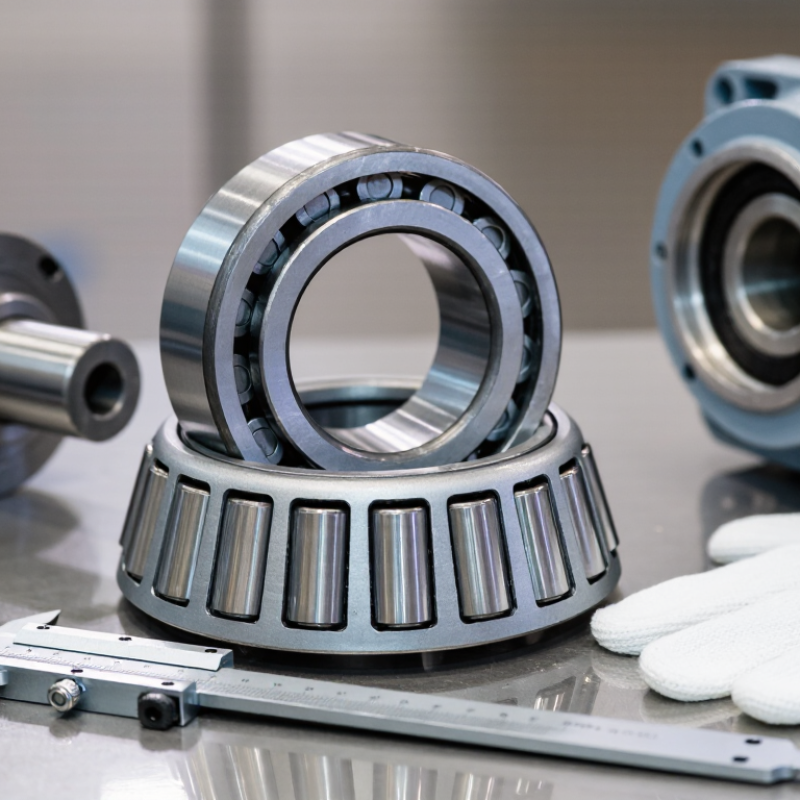
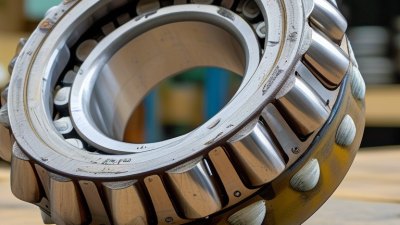
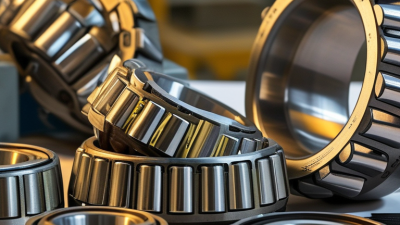
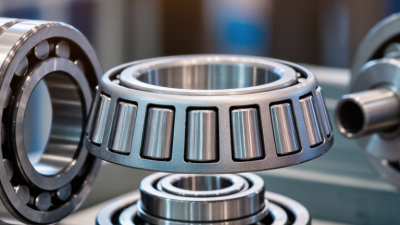
Tapered roller bearings use cone-shaped rollers between an inner cone and outer cup. Their angled contact lines let them support radial loads and axial thrust at the same time. A steeper contact angle generally increases axial-load capability, but can reduce radial capacity for a given bearing size. Small angles matter. Two bearings are often arranged face-to-face or back-to-back to control axial movement; correct adjustment depends on the shaft, housing, and operating temperature.
Load capacity is not a single safe-load figure. ISO 281:2007 calculates basic rating life using L10 = (C/P)^(10/3) for roller bearings, with life expressed in millions of revolutions. Here, C is the basic dynamic load rating and P is the equivalent dynamic load; L10 corresponds to 90% reliability under the standard’s assumptions. ISO 76:2006 addresses basic static load ratings, which help assess permanent deformation risks at rest or during shock loading. These ratings are useful, not guarantees. Lubrication, contamination, misalignment, and fit can shorten service life. A few microns of misalignment may matter. I would verify actual loads and duty cycles before selecting a bearing, since catalog calculations cannot capture every field condition.
| How to Choose Tapered Roller Bearings in 2026? — Understanding Tapered Roller Bearing Design and Load Capacity | ||||
|---|---|---|---|---|
| Selection Factor | Design or Data to Check | Load-Capacity Implication | Application Guidance | Verification Before Selection |
| Load direction | Tapered rollers and raceways generate a resultant force with both radial and axial components. | A single-row bearing can support combined loads, but its axial-load capacity is directional. | Use a single row where the axial load acts primarily in one direction and a locating arrangement is suitable. | Confirm the direction and magnitude of radial and axial loads, including load reversals. |
| Bearing arrangement | Common arrangements include single-row bearings mounted in pairs, double-row bearings, and four-row assemblies. | Opposed paired or multi-row arrangements can support axial loads in both directions and distribute loads across rows. | Choose the arrangement based on shaft support, available space, stiffness, and axial-load direction. | Check mounting orientation, spacer or adjustment requirements, and the intended locating or floating function. |
| Contact angle and geometry | The cone, cup, and roller geometry determines the bearing contact angle and internal force relationship. | A larger contact angle generally increases axial-load capability while affecting radial capacity and friction. | Compare bearing designs using the actual load combination rather than contact angle alone. | Use the specified geometry and calculation factors for the exact bearing designation. |
| Dynamic load rating | Basic dynamic load rating, C, is used with equivalent dynamic bearing load to estimate rating life. | A higher C can support a higher load for a given target life, but does not by itself determine service life. | Calculate life for the real load spectrum, operating speed, and required reliability. | Obtain C and the applicable life-calculation factors from the bearing’s technical data. |
| Static load rating | Basic static load rating, C₀, is assessed against the equivalent static load. | Static capacity matters during stationary loading, shock events, and low-speed operation. | Check peak loads and potential permanent deformation, especially in impact-prone equipment. | Apply the appropriate static safety factor for the application and operating conditions. |
| Axial adjustment and preload | Many tapered roller bearing arrangements require controlled endplay or preload after mounting. | Incorrect adjustment can raise operating temperature, reduce life, or allow excessive shaft movement. | Follow the equipment design’s specified setting method; do not assume a universal preload value. | Verify the adjustment procedure, measurement method, and limits for the specific assembly. |
| Speed and heat | Allowable speed depends on bearing size, lubrication, load, internal setting, and heat dissipation. | Higher speed and frictional heat can reduce lubricant life and increase the risk of damage. | Assess speed together with load and lubrication; a catalog speed limit is not a substitute for thermal review. | Check the rated speed conditions and evaluate operating temperature under the actual duty cycle. |
| Lubrication and contamination | Grease or oil must provide a suitable lubricating film; seals and cleanliness help limit contaminant ingress. | Insufficient lubrication or contamination can cause wear, overheating, and premature failure. | Select the lubricant and sealing approach for the speed, temperature, environment, and maintenance plan. | Confirm lubricant compatibility, relubrication intervals, sealing needs, and cleanliness requirements. |
| Shaft and housing fits | Fits, shoulders, and housing rigidity affect alignment, clearance, and load distribution. | Incorrect fits or misalignment can create uneven loading and shorten bearing life. | Design supporting components to maintain alignment and retain the rings under operating loads. | Check fit tolerances, shoulder dimensions, runout, and mounting instructions. |
| Data interpretation | Load ratings, limiting speeds, dimensions, and calculation factors vary by bearing size and design. | There is no single load-capacity value that applies to all tapered roller bearings. | Use this guide to screen design choices, then calculate and verify the selected bearing for the application. | Use current technical documentation for the exact bearing and confirm compliance with applicable standards. |