Leave Your Message

China Top Ball Bearings Manufacturers for Global Buyers

Choosing the right China top ball bearings manufacturers requires more than comparing prices or reviewing polished catalogues. Global buyers need consistent dimensions, controlled materials, reliable heat treatment, and responsive technical support. A bearing may look flawless in a product photograph, yet fail when exposed to vibration, dust, speed, or uneven loading. That reality makes supplier evaluation essential.

This guide examines China’s ball bearing manufacturing landscape from a practical purchasing perspective. It considers production experience, quality management, inspection equipment, export capability, and application knowledge. Buyers will also see how manufacturers handle steel sourcing, grinding accuracy, noise testing, lubrication, packaging, and traceability. These details matter in automotive components, industrial motors, agricultural machinery, conveyors, and precision equipment.

Small differences matter.

The term Bearings Ball may appear in search data, product pages, or buyer inquiries, but technical decisions should follow engineering requirements. Load ratings, clearance, sealing design, operating temperature, and installation conditions deserve careful review. Certifications can support confidence, although certificates alone cannot prove every shipment’s performance. Factory audits, sample testing, dimensional reports, and clear communication remain valuable.

No supplier suits every application. Some manufacturers offer broad product ranges, while others perform better with customised specifications or high-volume orders. Even experienced buyers can overlook packaging quality or after-sales response. This article aims to present useful comparisons without exaggeration, helping international purchasers identify capable partners and reduce avoidable sourcing risks. Careful verification is still necessary before any long-term agreement.
China Top Ball Bearings Manufacturers for Global Buyers

Ball Bearings: Types, Standards, and Industrial Applications

For global buyers, choosing ball bearings starts with load, speed, temperature, and installation space. Deep-groove bearings suit electric motors, pumps, and general machinery. Angular-contact bearings manage combined radial and axial loads. Tapered roller bearings support heavy loads and controlled axial forces. Spherical roller bearings tolerate shaft misalignment. Thrust bearings handle axial loads, but not every design accepts radial force. Each type has limits.

Standards make supplier comparisons more reliable. ISO 15 defines boundary dimensions for many rolling bearings, while ISO 492 covers dimensional and running accuracy. ISO 199 addresses thrust-bearing accuracy classes. Buyers should also review material specifications, internal clearance, sealing design, grease grade, and noise requirements. Chinese GB/T documents may align with international standards, but the exact edition matters. A certificate alone is not enough.

In supplier audits, examine raceway finish, cage quality, seal elasticity, packaging, and lot traceability. Check whether markings match inspection records. Electric motors often need low friction and controlled noise. Conveyors demand dependable sealing against dust. Machine tools require accuracy and thermal stability. Food-processing equipment needs suitable lubricants and cleanable surfaces. A perfect selection is rare. Real operating data should challenge the initial specification, especially when temperature, vibration, or contamination changes after installation.
How China’s Ball Bearing Manufacturing Industry Is Organized

China’s ball bearing industry is organized as a layered manufacturing network, not one unified factory system. The China Bearing Industry Association’s 2023 industry statistics reported roughly 25 billion bearing sets produced and industry revenue above RMB 270 billion. These figures show scale, but they hide major differences in quality, technology, and export experience.

At the upstream level, specialized mills supply bearing steel, while forging workshops shape rings and balls. Heat-treatment plants then control hardness and internal structure. Precision factories perform turning, grinding, superfinishing, cleaning, and assembly. Many suppliers focus on one stage only. This division lowers costs and supports large orders. It can also create traceability gaps. A buyer should request material certificates, process records, dimensional reports, and batch-level inspection data.

The middle layer includes independent manufacturers, contract producers, and suppliers serving machinery, automotive, agricultural, and industrial equipment sectors. Export agents and regional distributors connect them with overseas buyers. According to UN Comtrade data for HS 848210, China remains one of the world’s largest exporters of ball bearings by shipment value. However, trade volume alone does not prove consistency. ISO 281 calculations help compare dynamic load ratings, but real performance also depends on lubrication, sealing, mounting, and operating temperature. This is where procurement decisions often become too simple. A low quotation may reflect a different inspection scope, not better efficiency. Careful buyers usually compare samples, audit production lines, and verify test methods before approving regular shipments.

Leading Chinese Ball Bearing Manufacturers and Their Product Strengths

China’s ball bearing manufacturers serve automotive, electric motor, agricultural, and industrial equipment markets worldwide. A 2024 Grand View Research report estimates the global ball bearing market will grow at about 4.8% annually through 2030. This demand rewards suppliers with stable quality, not only large production capacity.

Leading Chinese manufacturers commonly offer deep-groove, angular-contact, self-aligning, and miniature ball bearings. Their strengths often include automated grinding, controlled heat treatment, and sealed designs for dusty workshops. Many factories inspect raceway geometry, radial clearance, vibration, and noise before shipment. Buyers should request results linked to ISO 492 accuracy classes. A clean inspection record matters more than a polished catalog.

Material selection is another practical advantage. Chrome steel supports general industrial loads, while stainless steel suits humid environments and food-processing equipment. Ceramic hybrid options can reduce electrical damage in high-speed motors, but they cost more. According to a 2023 industry analysis by Fortune Business Insights, electric motors and automotive applications remain major demand areas for bearing suppliers. Chinese factories can also adjust grease, seal structure, and internal clearance for specific operating conditions. The fit is not always perfect. Some product pages still provide limited fatigue-life data. Serious buyers should verify load ratings, batch traceability, dimensional reports, and sample performance before placing volume orders.cuntegn

Quality Certifications and Testing for Global Bearing Buyers

China Top Ball Bearings Manufacturers for Global Buyers

Quality begins with evidence, not a supplier’s brochure. ISO 9001 certification shows a controlled quality system, but it does not guarantee every bearing is defect-free. The ISO Survey 2023 recorded more than 1.26 million valid ISO 9001 certificates worldwide. Buyers should still verify certificate scope, issuing body, and expiration date. Ask for batch-level inspection records.

Testing should match the bearing’s working conditions. Dimensional checks confirm bore and outside diameter accuracy. Hardness testing protects against premature raceway damage. Surface roughness measurements help control friction and noise. Vibration testing can reveal contamination, waviness, or internal clearance problems. ISO 281 provides a recognized method for calculating basic rating life under defined loads and speeds. It is useful, but real service life may differ.

Cleanliness matters greatly. Tiny metal particles can mark a raceway like sand under a wheel. Request grease specifications, sealing checks, and cleanliness results using a documented method. A 2024 Grand View Research report valued the global bearing market at tens of billions of dollars, reflecting strong demand but also intense supplier competition. That pressure can encourage optimistic claims. Certificates may be genuine, yet sampling plans can miss irregular defects. Buyers should compare test data with incoming inspection results and investigate repeated failures instead of accepting convenient explanations.

China Top Ball Bearings Manufacturers for Global Buyers — Quality Certifications and Testing

ISO 492 defines bearing dimensional and rotational-accuracy classes. The chart presents the recognized precision-class sequence from standard precision to the tightest class. The ranking is ordinal and does not represent any manufacturer, brand, market share, or specific tolerance value.

For global procurement, buyers should request the applicable ISO 492 precision class together with dimensional inspection records, noise and vibration results, hardness verification, material traceability, and the supplier’s current quality-management certification. Precision-class availability and testing capability should always be confirmed against the individual product specification.

How to Evaluate, Select, and Source Bearings from China

China Top Ball Bearings Manufacturers for Global Buyers

How to Evaluate, Select, and Source Bearings from China

Choosing a bearing supplier requires more than comparing prices. Start with your operating conditions: radial load, speed, temperature, moisture, and expected service life. Ask for dimensional drawings, material specifications, hardness results, and load ratings. A reliable manufacturer should explain tolerance classes clearly and provide batch-level traceability.

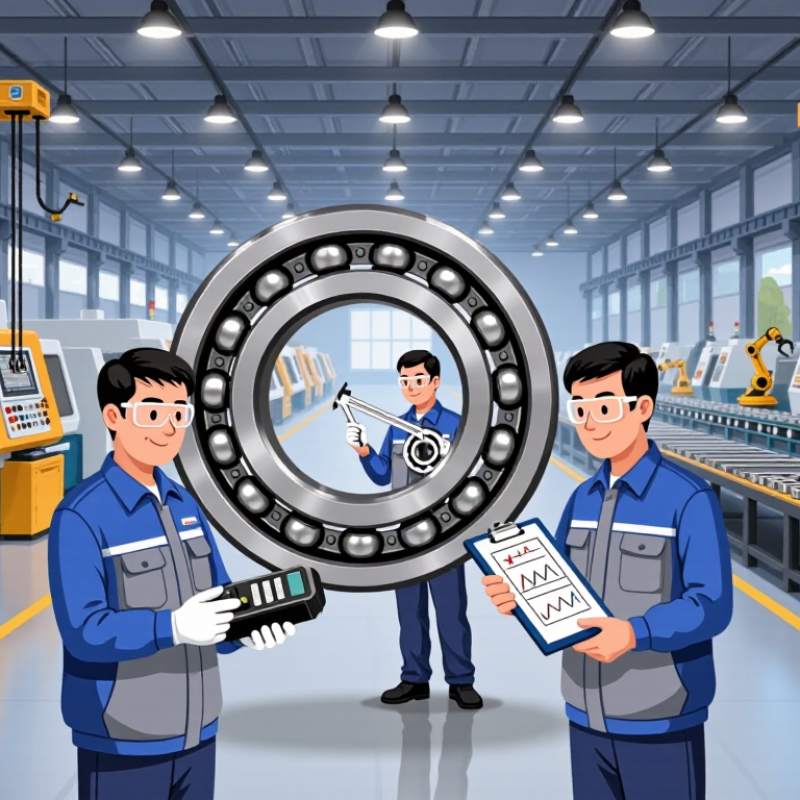
Request samples from the same production line used for regular orders. Inspect bore diameter, outer-ring finish, seal condition, and rotation noise. Use calibrated tools, not visual judgment alone. Ask for inspection reports and independent testing when the application is critical. Factory experience matters, but documented process control matters more. Visit the facility if possible, or arrange a qualified third-party audit.

Small details often reveal sourcing quality. Check whether bearings are packed with corrosion protection, labeled by batch, and separated from dusty components. Confirm production lead times, replacement procedures, payment terms, and shipping responsibilities in writing. I once underestimated packaging during a humid shipment; the parts arrived usable but needed extra cleaning. That mistake changed my supplier checklist. Certificates can look impressive. Verify them. A low quotation may exclude testing, custom packaging, or after-sales support. Compare the complete delivered cost, not only the unit price. Test a small order before committing to volume. The best choice is not always the cheapest or the most polished; it is the supplier whose evidence remains consistent under practical review.

China Top Ball Bearings Manufacturers for Global Buyers - How to Evaluate, Select, and Source Bearings from China

Bearing Type Primary Load Capability Misalignment Capability Common Sealing Options Typical Applications Key Selection Factors Recommended Verification Documents
Deep Groove Ball Bearing Supports radial loads and moderate axial loads in both directions. Low; requires accurate shaft and housing alignment. Open, metal-shielded, or contact-sealed designs. Electric motors, pumps, fans, gearboxes, conveyors, and general machinery. Load rating, speed requirement, internal clearance, operating temperature, and seal friction. Dimensional inspection report, material certificate, noise and vibration results, and batch traceability.
Angular Contact Ball Bearing Handles combined radial and axial loads; axial capacity depends on contact angle. Low; mounting arrangement and preload are important. Usually open for precision applications; sealed versions are also available. Machine-tool spindles, pumps, compressors, robotics, and precision equipment. Contact angle, preload, paired arrangement, speed rating, stiffness, and running accuracy. Accuracy-class report, preload measurement, runout data, steel certificate, and inspection records.
Self-Aligning Ball Bearing Primarily radial loads with limited axial load capability. Good; accommodates shaft or housing misalignment within the design limit. Open, shielded, or sealed options depending on the series. Long shafts, agricultural equipment, conveyors, textile machinery, and applications with mounting deflection. Permissible angular misalignment, radial clearance, load rating, and sealing performance. Angular misalignment test, dimensional report, clearance report, and visual inspection record.
Thrust Ball Bearing Designed mainly for axial loads; radial loads should generally be limited. Very low; requires parallel and properly supported mounting surfaces. Commonly open; external protection may be required. Low-speed screw mechanisms, turntables, vertical shafts, and axial positioning systems. Axial load direction, speed, washer flatness, lubrication, and mounting orientation. Axial load test, washer flatness report, hardness report, and dimensional inspection data.
Tapered Roller Bearing High radial and axial load capacity; axial load is normally carried in one direction per bearing. Low to moderate; accurate adjustment is required. Generally open and protected by the housing or external seals. Vehicle wheel hubs, reducers, heavy-duty gearboxes, and industrial transmission systems. Equivalent dynamic load, preload or endplay, operating temperature, lubrication, and pair arrangement. Geometry report, roller profile inspection, hardness certificate, endplay or preload record, and load-test data.
Spherical Roller Bearing Very high radial load capacity with moderate axial load capacity. Good; suitable for shaft deflection and housing misalignment within the specified limit. Usually open; external seals are normally integrated into the housing. Mining equipment, crushers, paper machinery, fans, conveyors, and heavy industrial systems. Radial load, axial load, allowable misalignment, internal clearance, lubrication method, and cage design. Roller and raceway inspection, clearance report, material certificate, dimensional report, and traceability records.
Needle Roller Bearing High radial load capacity for a compact cross-section; limited axial capability unless separately guided. Low; requires proper shaft hardness, roundness, and alignment. Open, sealed, drawn-cup, or machined-ring configurations. Automotive transmissions, planetary gears, pumps, compressors, and compact mechanisms. Available radial space, shaft raceway quality, lubrication, load distribution, and stroke or rotation pattern. Shaft raceway requirements, dimensional inspection, hardness report, roller diameter variation, and cage inspection.
Insert Bearing with Housing Moderate radial loads with limited axial loads depending on the locking arrangement. Moderate; spherical outer rings can compensate for limited housing misalignment. Contact seals, flingers, and multi-lip sealing arrangements are common. Conveyors, agricultural machinery, fans, processing equipment, and material-handling systems. Housing material, shaft-locking method, sealing design, mounting base, corrosion environment, and relubrication needs. Housing dimensional report, locking-torque test, seal inspection, grease specification, and corrosion test data.
Evaluation Dimension What Global Buyers Should Check Common Reference or Test Basis Practical Sourcing Guidance
Dimensional Accuracy Bore diameter, outside diameter, width, chamfer dimensions, and mounting tolerances. ISO 492 bearing accuracy classifications and applicable product drawings. Approve a controlled drawing and require inspection data from production batches rather than relying only on sample approval.
Radial Internal Clearance Clearance must match the shaft fit, housing fit, speed, temperature, and operating load. ISO 5753-1 clearance classifications, such as normal, C3, and other specified classes. Specify the clearance class on the purchase order and request measured results for critical applications.
Load and Rating Life Dynamic load rating, static load rating, equivalent load, speed, and required service life. ISO 281 rating-life methodology for rolling bearings. Calculate the required life using the actual load and speed profile; do not select solely by bore size.
Material and Heat Treatment Raceway and rolling-element steel grade, hardness, cleanliness, carburizing or through-hardening process. Applicable bearing-steel specifications, approved material certificates, and metallurgical test procedures. Request lot-specific certificates and define acceptance limits for hardness, microstructure, and non-metallic inclusions.
Noise and Vibration Running noise, vibration level, surface finish, waviness, and balance of rotating components. ISO 15242 measurement principles and the buyer's approved noise or vibration grading method. Use the same test speed, lubrication, instrument setup, and acceptance limit for supplier comparison.
Lubrication Grease or oil type, base oil viscosity, thickener, fill quantity, relubrication interval, and compatibility. OEM application requirements, lubricant technical data sheets, and compatibility testing. Specify lubricant brand-independent technical requirements where possible and validate compatibility before changing grease.
Sealing and Environmental Protection Dust, water, chemical exposure, temperature, contamination, and friction requirements. Supplier seal design data, ingress testing, temperature limits, and application-specific validation. Choose the seal construction for the environment rather than selecting a sealed code only by price.
Quality Management Process control, calibration, nonconforming-product control, traceability, and corrective-action procedures. ISO 9001 certification and documented inspection and quality-control procedures. Verify the certificate scope and audit the actual production site when the order is safety-critical or high volume.
Pre-Shipment Inspection Quantity, markings, packaging, dimensions, clearance, appearance, noise, and documentation. Approved inspection plan, sampling standard, purchase specification, and agreed acceptance criteria. Use independent or buyer-authorized inspection for the first order and for periodic production batches.
Packaging and Logistics Rust prevention, moisture protection, individual packaging, carton strength, labeling, and storage life. Agreed packaging specification, export shipping requirements, and product shelf-life instructions. Confirm packaging before production and require lot numbers that connect the shipment to inspection records.
Reference framework for evaluating and sourcing bearings from China. Final selection should be based on the application load, speed, temperature, environment, fit, required service life, and verified supplier documentation.